High-Ticket Insight #9
Your High-Ticket Offer Should Not Sound Like More Work
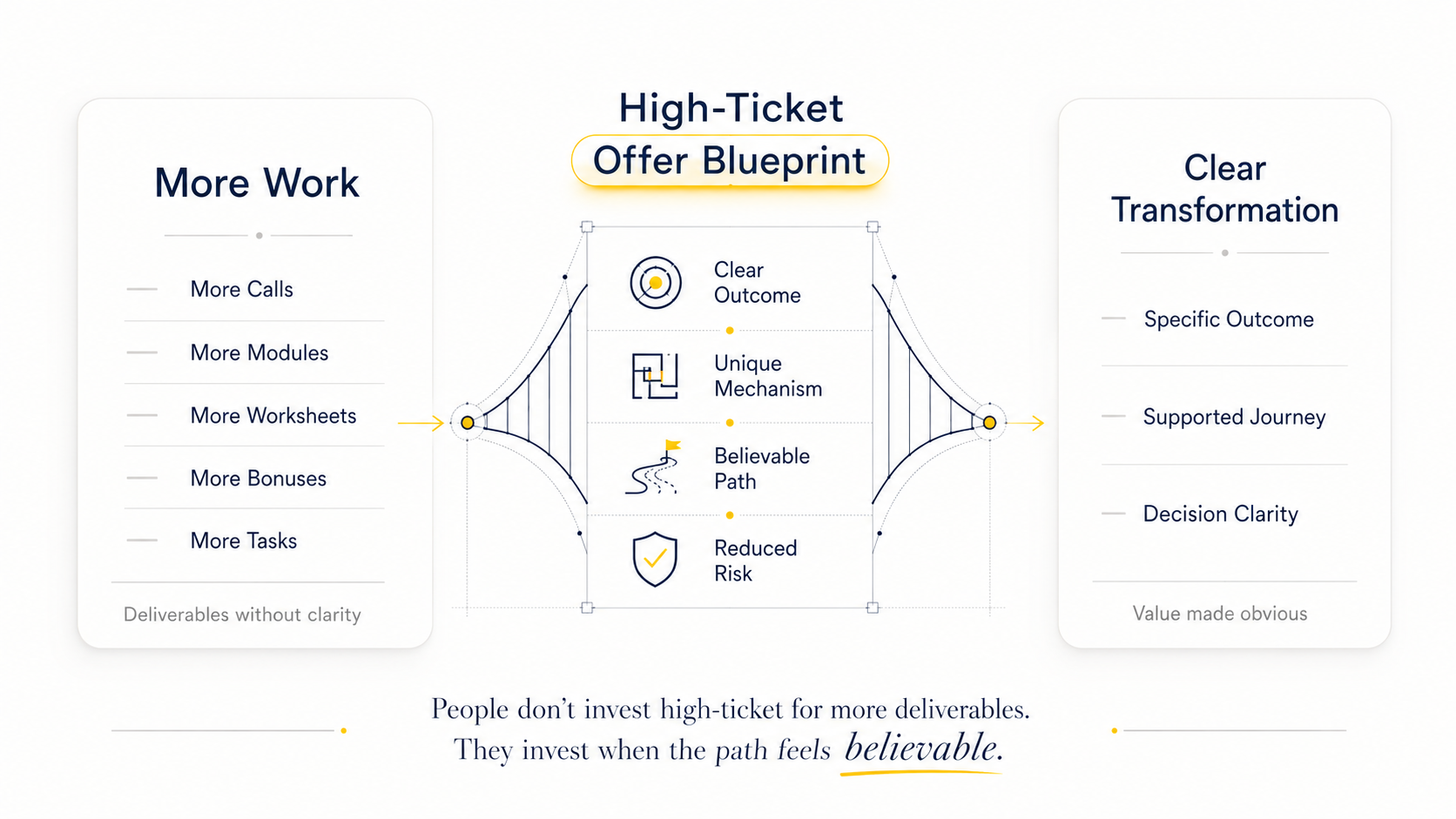
A high-ticket offer should not feel like more calls, modules, and tasks. It should make the transformation, method, support, and investment feel clear, believable, and difficult to say no to.
Most coaches think their offer becomes more valuable when they add more to it.
More calls.
More modules.
More worksheets.
More bonuses.
More community access.
More support.
And on paper, that looks like value.
But to a high-ticket prospect, it can often feel like something else.
More work.
And that is where the problem begins.
Because when someone is considering investing at a high-ticket level, they are not just evaluating the price.
They are evaluating the time it will take.
The effort it will require.
The opportunity cost of staying where they are.
The risk of making the wrong decision.
And most importantly, whether you are the right person to walk them through the journey.
So the offer is not just a list of deliverables.
The offer is the reason the investment makes sense.
The Problem
A lot of coaches build their high-ticket program from the inside out.
They start with what they want to include.
12 weeks.
8 calls.
4 modules.
Templates.
Assignments.
A WhatsApp group.
Bonus trainings.
Lifetime access.
But your prospect is not sitting there thinking:
“How many things will I get?”
They are thinking:
“Will this actually help me solve the problem I care about?”
That is the real question.
And if your offer does not answer that question clearly, the investment feels heavy.
Not because your coaching is not valuable.
But because the value has not been packaged in a way that makes the decision obvious.
The Misconception
The misconception is that a high-ticket offer needs to sound comprehensive.
So the coach keeps adding more.
But more does not always increase value.
Sometimes, more increases friction.
Because the prospect starts thinking:
“Will I have time for this?”
“Will I be able to keep up?”
“Is this going to become another thing I start and don’t finish?”
“What exactly changes for me at the end of this?”
This is why a high-ticket offer cannot just be a bigger version of a low-ticket product.
A high-ticket offer needs to create clarity.
It needs to show the prospect the transformation, the path, the support, the proof, the risk reversal, and the reason why delaying the decision has a cost.
The Insight
Here’s the insight.
A high-ticket offer becomes difficult to say no to when the prospect can clearly see three things:
Where they are now.
Where they want to go.
And why your method is the most believable bridge between the two.
That is what makes the offer powerful.
Not the number of calls.
Not the number of videos.
Not the number of bonuses.
Those things can support the offer, but they are not the offer.
The offer is the transformation, packaged in a way that makes the investment feel logical, valuable, and urgent.
This is why the single sentence offer matters.
Something like:
“I help [specific person] achieve [specific outcome] through [unique method] without [painful trade-off].”
But that sentence is only the compressed version.
Behind that one sentence, there has to be a deeper blueprint.
Who exactly is this for?
What problem are they really trying to solve?
What belief needs to shift?
What is your unique mechanism?
What journey will you take them through?
What proof makes the promise believable?
What risk are they afraid of?
How should the price be structured?
What makes the final pitch feel clear instead of forced?
That is the difference between having a coaching program and having a high-ticket offer.
The Next Step
Before you rewrite your ads, landing page, webinar, or sales script, review the offer itself.
Because if the offer is unclear, everything after it becomes harder.
Your marketing becomes vague.
Your sales call carries more weight.
Your price feels more expensive.
Your prospect compares you to cheaper alternatives.
And you end up trying to convince people instead of leading them.
That is why I built OfferIQ.
OfferIQ helps coaches build a High-Ticket Offer Blueprint across 11 sections:
- Premium Buyer Profile
- Problem Reframe
- Unique Mechanism
- Transformation Journey
- Offer Architecture
- Proof Strategy
- Risk Reversal
- Premium Enrollment Strategy
- Price Architecture
- Final Offer Pitch
- Conversion Angles
The goal is not just to create a better sounding offer.
The goal is to make your high-ticket program easier to understand, easier to trust, and more difficult to say no to.
Because people do not invest high-ticket because your offer has more inside it.
They invest because the outcome feels important, the path feels believable, and staying where they are feels more expensive than moving forward.