High-Ticket Insight #8
You Can’t Sell High-Ticket With Low-Ticket Energy
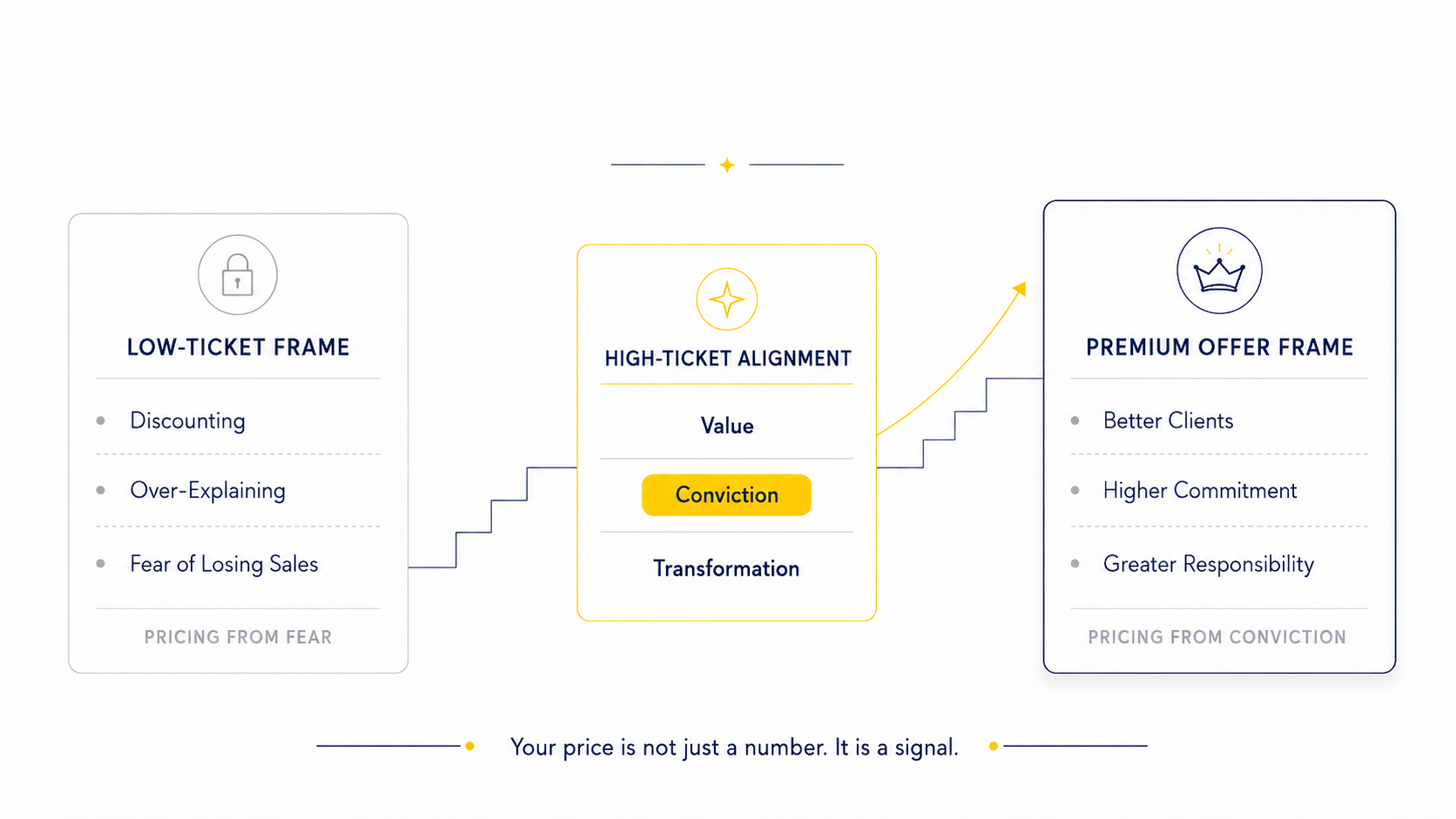
Many coaches are afraid to increase their price because they fear losing conversions. But higher prices often create better commitment, better clients, and stronger alignment when the coach has the conviction to hold the value.
The Problem
Many coaches want to charge high-ticket prices.
But emotionally, they are still afraid of losing the sale.
So they underprice.
They discount.
They over-explain.
They add more bonuses.
They try to make the offer feel “safe” for the prospect.
And on the surface, this looks practical.
Because the fear is understandable.
“What if fewer people buy?”
“What if people say it is too expensive?”
“What if I lose conversions?”
“What if the market does not accept this price?”
But underneath all of this, there is usually a deeper conflict.
The coach wants to be seen as premium.
But they do not fully feel premium yet.
They want clients to invest at a higher level.
But they are not always investing at a higher level themselves.
They want to charge for transformation.
But they are still pricing based on comfort.
And that creates a mismatch.
Because high-ticket pricing is not just about changing the number.
It is about changing the frame.
The Misconception
Most coaches think increasing the price will automatically reduce conversions.
But that is not always true.
Sometimes, increasing the price actually improves the quality of the conversation.
Because when the price is too low, it can attract people who are curious, but not committed.
People who want access, but not accountability.
People who say yes easily, but do not show up fully.
People who need constant convincing, reminding, and chasing.
A higher price can create a stronger filter.
It can attract prospects who take the work more seriously.
It can increase the perceived value of the transformation.
It can create more commitment from the client.
And it can help the coach show up with more seriousness, structure, and responsibility.
Of course, this does not mean you randomly increase your price without improving the offer.
The value still needs to be there.
The promise needs to be clear.
The positioning needs to be strong.
The sales process needs to support the decision.
But the fear that “higher price means fewer conversions” is often too simplistic.
Sometimes, the lower price is the very reason you are attracting lower-quality clients.
The Insight
If you want to sell high-ticket, you also need to become a high-ticket investor.
Not just in money.
But in identity.
In standards.
In conviction.
In the level of transformation you believe is possible.
Because it is hard to ask someone to make a serious investment if you are not willing to make serious investments yourself.
It is hard to hold a premium price if you personally keep choosing the cheapest path.
It is hard to communicate value with conviction if you are not in alignment with the level of value you are asking someone else to see.
This does not mean you need to spend recklessly.
It means you need to understand what it feels like to invest at a higher level.
To feel the discomfort.
To make the decision.
To back yourself.
To experience the difference between consuming information and committing to transformation.
That alignment matters.
Because premium pricing is not only a marketing decision.
It is an identity decision.
A coach who charges ₹5,000 and a coach who charges ₹1,25,000 are not simply using different numbers.
They are holding a different frame.
They are attracting a different client.
They are creating a different level of commitment.
They are taking a different level of responsibility.
I have seen this happen with clients.
A relationship coach went from charging ₹5,000 through a live webinar to directly charging ₹1,25,000 for her offer.
An ecommerce coach moved from a low-ticket 5-day challenge and ₹25,000 offer to charging ₹75,000.
The increase was not just about the price.
It came from repositioning the offer, strengthening the promise, improving the sales frame, and helping the coach believe that the transformation deserved a higher level of investment.
That is the real shift.
Not just “charge more.”
But become the kind of coach who can hold the higher price with conviction.
Next Step
This is where many coaches need to review their pricing from the inside out.
Not just:
“What should I charge?”
But:
“Do I believe this transformation is worth more?”
“Am I attracting the kind of clients I actually want to work with?”
“Is my current price filtering serious buyers or inviting casual interest?”
“Does my offer create enough value to justify a higher investment?”
“Do I have the conviction to hold the price without collapsing?”
Because your price is not just a number.
It is a signal.
It tells the prospect how seriously to take the work.
It tells the market where to place you.
And it tells you what level of responsibility you are choosing to hold.