High-Ticket Insight #10
Not Every Lead Should Become A Client
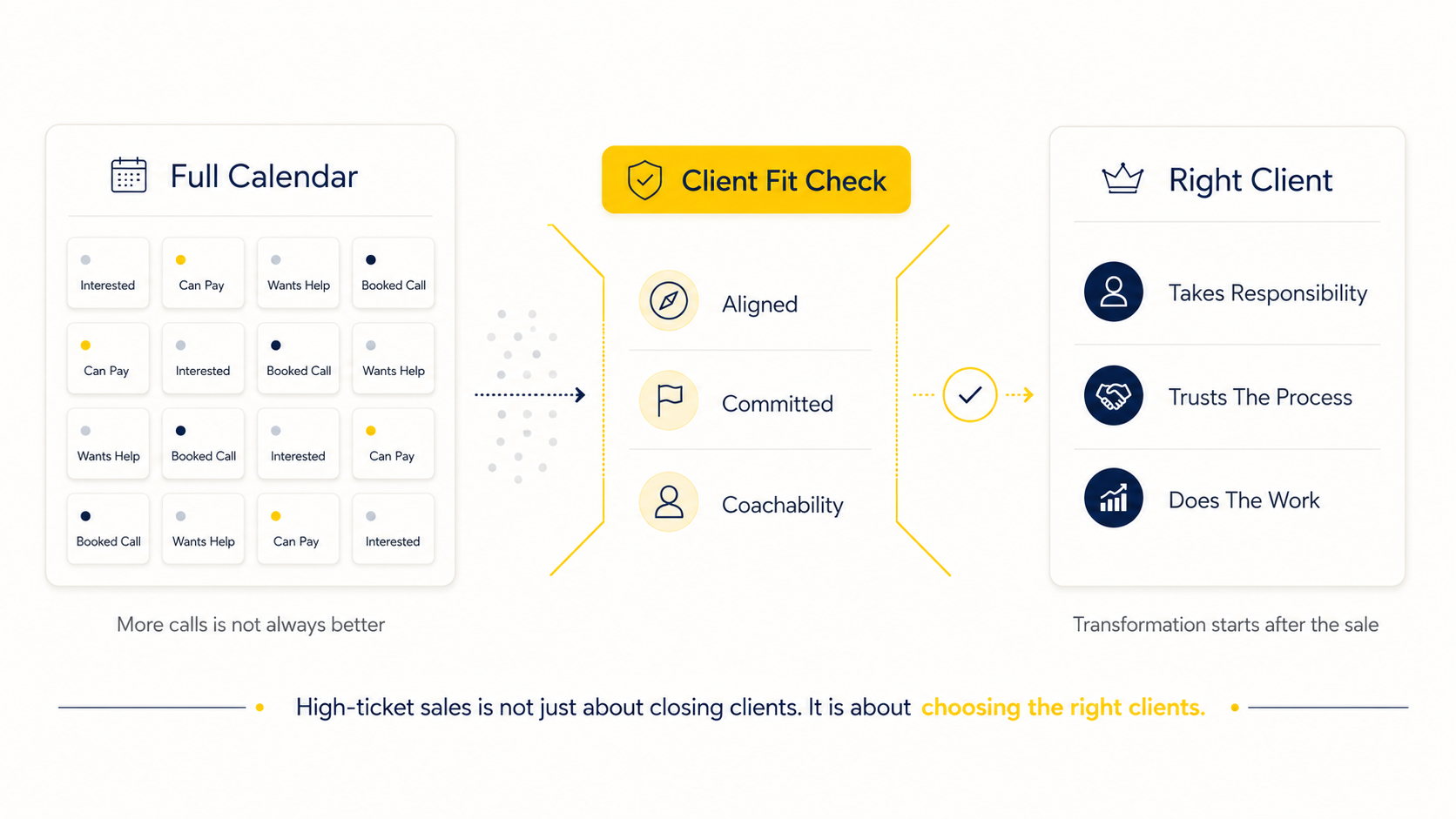
In high-ticket coaching, the goal is not just to fill your calendar. It is to choose clients who are aligned, committed, and capable of creating transformation.
Most coaches are busy trying to fill their calendar.
More leads.
More calls.
More applications.
More opportunities.
And of course, leads matter.
But one of the most important parts of building a high-ticket coaching business is not just getting people on your calendar.
It is making sure the right people are on your calendar.
Because in a high-ticket coaching business, the real work does not start when someone pays you.
The real work starts after they pay you.
That is when transformation has to happen.
The Problem
A lot of coaches treat every sales call like the goal is to close.
If the person has money, they are interested, and they are willing to pay, then the instinct is to say yes.
Especially in the early stages.
I know this personally.
When I started, almost any coach could become my client.
If they liked what I did, if they were willing to invest, and if I believed I could help in some way, I would often take them on.
But over time, I learned something important.
Not every person who can pay is the right person to serve.
And if you deeply care about your work, this can become emotionally heavy.
Because when someone does not get the result, you do not just look at it as a business outcome.
You start carrying it personally.
You start wondering:
Did I not do enough?
Did I miss something?
Could I have helped them more?
And if you are empathetic, if you genuinely care about your clients, the wrong client can take a much bigger emotional toll than you expected.
The Misconception
Most coaches think the hard part is getting clients.
But in high-ticket coaching, getting the client is only the first part.
Helping them achieve transformation is harder.
Because now you are dealing with their habits, their beliefs, their execution, their resistance, their environment, and their ability to actually do the work.
This is why taking money from anyone is not a strategy.
It is a risk.
If someone is clearly not ready to take action, not willing to be honest, not able to follow through, or not aligned with the way you work, then saying yes may feel good in the moment.
But later, it can damage the relationship.
It can damage the result.
And it can damage your own confidence as a coach.
This is where many coaches blur the line between being helpful and being responsible for everything.
You can guide someone.
You can support someone.
You can create the right environment.
But you cannot do the transformation for them.
The Insight
Your sales call is not just where the prospect decides if they want to work with you.
It is also where you decide if you want to work with them.
That is a very important shift.
A high-ticket sales conversation should not feel like you are begging someone to say yes.
It should feel like both sides are evaluating fit.
Can you help this person?
Are they aligned with your process?
Do they respect the level of work required?
Are they willing to take responsibility?
Is this the kind of client you want to build results with?
Because your calendar should not just be full.
It should be full of the right people.
This is why offer clarity matters.
This is why ideal audience clarity matters.
This is why positioning matters.
This is why your funnel should attract, inspire, qualify, and prepare the right leads before the call.
The better your pre-call experience, the less your sales call becomes about convincing.
And the more it becomes about confirming fit.
The Next Step
If you know someone is not the right fit, you have the right to say no.
In fact, in a high-ticket coaching business, saying no is part of ethical selling.
Money can be tempting.
Especially when someone is ready to pay.
But if you already know they are unlikely to do the work, unlikely to respect the process, or unlikely to benefit from your offer, then taking their money is not clean.
It may help revenue in the short term.
But it can cost you in results, testimonials, referrals, reputation, and peace of mind.
The goal is not to work with everyone.
The goal is to build a business where the right people enter your world, understand your value, and show up to the sales conversation with clarity.
Because high-ticket coaching is not just about closing clients.
It is about choosing the right clients to create transformation with.