High-Ticket Insight #7
Don’t Reveal The Price Too Early
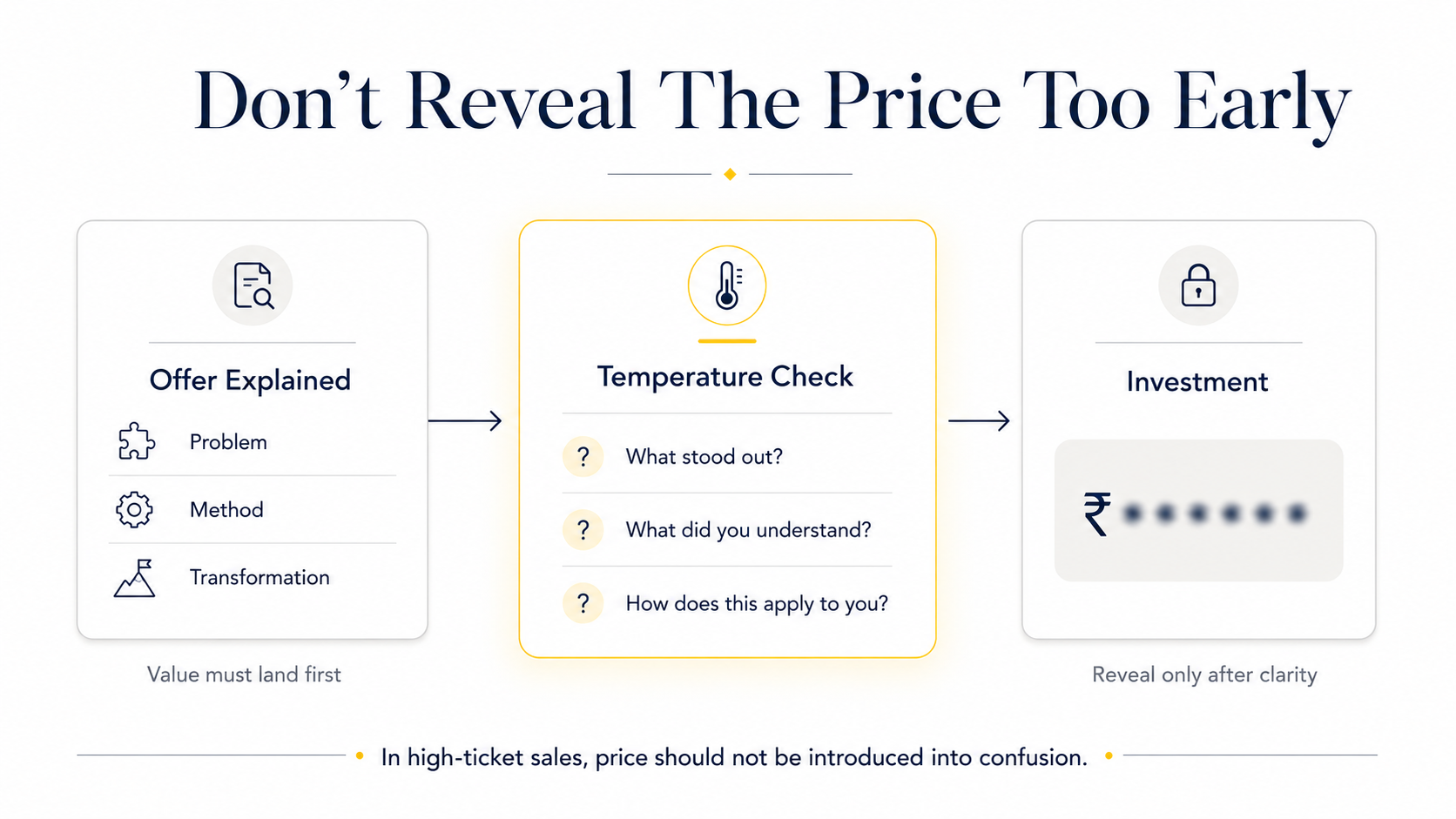
Before revealing the investment on a high-ticket sales call, make sure the prospect has clearly understood the value.
The Problem
Most high-ticket coaches reveal the price too quickly on a sales call.
They explain the offer.
They talk about the modules.
They explain the support.
They describe the transformation.
And then, almost automatically, they say:
“The investment is…”
But here’s the problem.
Just because the coach has finished explaining the offer does not mean the prospect has understood the offer.
And in high-ticket sales, that difference matters.
Because price is not heard in isolation.
Price is heard through the lens of the prospect’s understanding.
If the prospect understands the problem clearly, sees the cost of inaction, values the methodology, and connects the offer to their own situation, the price has context.
But if they are confused, distracted, passive, or unclear, the same price can suddenly feel expensive.
Not because the offer is weak.
But because the value has not landed yet.
The Misconception
Most coaches believe that once the offer has been explained, the next natural step is to reveal the price.
But explanation is not the same as understanding.
A prospect can listen politely and still not fully grasp the value.
They can nod along and still not see why this matters now.
They can say “sounds good” and still not be emotionally or strategically ready to make a decision.
This is why many coaches face resistance after revealing the price.
- “I need to think about it.”
- “Can you send me the details?”
- “It sounds expensive.”
- “I’ll get back to you.”
The issue is not always affordability.
Sometimes, the issue is that the prospect was never properly primed, pre-framed, or challenged before hearing the investment.
The Insight
Before revealing the price, you need to do a temperature check.
A temperature check is a simple question that helps you understand whether the prospect is actually following, processing, and connecting with what you are saying.
For example, after explaining the offer, you can ask:
- “What stood out to you most from what I just explained?”
- “How do you see this helping you with your current situation?”
- “What part of this feels most relevant to where you are right now?”
- “Can you share what you understood about the way this process works?”
These questions are not random.
They help you understand whether the value has actually landed.
If the prospect gives a thoughtful answer, connects the offer to their own problem, and explains what they liked or understood, that is a good sign.
It means they are engaged.
It means they are processing.
It means they are more prepared to hear the price.
But if they respond vaguely with something like:
“Yeah, sounds good.”
Or:
“Okay, interesting.”
Or they repeat only surface-level details, that is a signal.
It does not mean they are not qualified.
But it does mean you should not rush into the price yet.
Because in high-ticket sales, price should not be introduced into confusion.
Price should be introduced into clarity.
Next Step
This is why sales call reviews matter.
Because many coaches only review the outcome of a call.
- Did the prospect buy?
- Did they object?
- Did they ghost?
- Did they ask for time?
But the more useful question is:
Where did the call lose clarity?
- Did the prospect understand the problem deeply enough?
- Did they connect the offer to their own situation?
- Did the coach challenge their thinking before moving to the price?
- Did the investment come after clarity, or was it introduced into confusion?
These are the moments that often determine whether the price feels justified or expensive.
And without reviewing the actual call, most coaches are only guessing.
This is where ConvertIQ comes in.
ConvertIQ helps you review your sales calls and identify the moments where clarity, trust, challenge, and conversion either strengthened or broke down.
So instead of only asking why a prospect did not buy, you can see what actually happened inside the conversation.